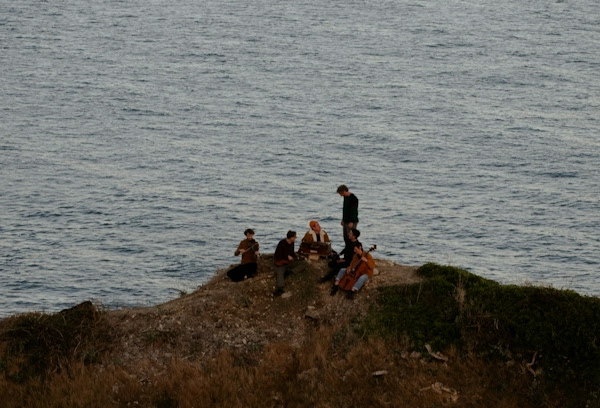
Garefowl Share Mesmerising New Video for ‘Buthaigir/Puffin’ from Album Things That Vanish
Scottish experimental folk collective Garefowl have unveiled a striking new video for ‘Buthaigir/Puffin’, a track taken from their recently released second album, Things That Vanish, out now via independent record label AD 93. Combining experimental animation, stop-motion techniques and atmospheric footage captured on the remote Scottish island of St Kilda, the video offers a fascinating visual companion to the band's distinctive musical world.
Directed by Luke Nairn and animated by Liam Painter, the video brings together live stop-motion stone animations, 16mm performance footage and behind-the-scenes material from the recording sessions on St Kilda.
Inspired by the unusual creative process behind the album, the film reflects the relationship between the musicians and the dramatic natural environment that shaped the recordings.
Director Luke Nairn explains:
"I was so inspired by how the actual album was made that I really wanted the video to reflect the recording process and how the band worked with their surrounding environment on St. Kilda. I started having conversations with animator Liam Painter about how we could pull this off and we landed on a stop-motion dance with rocks, inspired by a piece made in the 60s by legendary Czech animator and filmmaker Jan Svankmajer. Bringing performance and the animation together felt like the right way to honour the emotion of the music and the project's roots; I very much wanted it to feel like you're flipping through a picture book about a folk tale."
The resulting visual work captures the mysterious atmosphere of Garefowl's music, combining organic imagery and experimental filmmaking to create something that feels both ancient and otherworldly.
Watch the new video for ‘Buthaigir/Puffin’ and discover the world of Garefowl's Things That Vanish.
Things That Vanish: An Album Inspired by the Wild Landscape of St Kilda
Garefowl are an international collective of musicians connected to the remote archipelago of St Kilda, Scotland. Their music brings together traditional string instruments, folk influences and experimental electronics, creating atmospheric compositions that draw heavily on the islands' natural environment and cultural history.
Released on 2 October via AD 93, their second album, Things That Vanish, was recorded at night on Hirta, the main island of St Kilda.
The surrounding landscape plays an essential role throughout the record. Rather than simply providing a backdrop for the music, the sounds of Hirta become an integral part of its identity.
Winds, waves, seabirds and the distinctive, almost otherworldly calls of the snipe drift through the recordings, creating an immersive sonic portrait of one of Scotland's most remote and atmospheric locations.
Drawing inspiration from traditional St Kildan folk music, the album's compositions are based around the threatened seabirds of the islands.
The birds featured include puffin, guillemot, storm petrel, cormorant, shearwater, kittiwake, gannet, bonxie and fulmar.
The collective became particularly interested in the folklore surrounding these creatures and the darker stories associated with them.
In traditional island tales, seabirds are sometimes portrayed as mysterious and threatening beings, almost resembling sea monsters. Stories describe them preying upon livestock or representing the pelagic souls of drowned sailors and the cursed spirits of cruel sea captains.
These haunting associations provide an imaginative starting point for the music, giving Things That Vanish a strong connection to the folklore, landscape and natural history of St Kilda.
Creating Music Without Synthesizers
One of the most fascinating aspects of Things That Vanish is the experimental recording and production process behind it.
Despite its atmospheric electronic textures, no synthesizers were used during the recording.
Instead, the album's soundscapes were created entirely from sampled and processed field recordings and hydrophone recordings collected on St Kilda.
The musicians also experimented with physical samples of rocks and bones gathered from the island, which were used to generate distinctive drones by Richard O'Flynn and Joe Gardner.
These materials were analysed using X-ray diffraction (XRD), a scientific technique that produces a spectrum of peaks corresponding to the crystalline structure of a sample.
Using a method developed by Bill Sethares at the University of Wisconsin, the peaks in each spectrum were converted into individual sine waves unique to each sample.
These frequencies were then blended together to create the drones heard throughout the album.
The result is an unusual meeting point between natural history, scientific analysis, traditional instrumentation and experimental sound design.
Rather than relying on conventional electronic synthesis, Garefowl have developed an approach in which the physical materials of St Kilda itself become part of the musical composition.
A Family History Behind the Garefowl Project
The story of Garefowl goes back beyond the band's first recordings.
The project was originally conceived by Ewan Macdonald and his father Murdo as a way of reflecting on and acknowledging their family connection to one of the men involved in killing the last Great Auk, also known as the Garefowl.
The Great Auk became extinct in the nineteenth century, making the band's name and wider creative concept particularly significant.
The project explores themes of disappearance, memory, folklore and humanity's relationship with the natural world.
These ideas run throughout Things That Vanish, an album that draws attention to threatened seabirds and the fragile environments in which they live.
The current Garefowl line-up comprises:
- Nathan Bontrager – viola da gamba, harmonium and banjo.
- Stuart Graham – bouzouki, harmonica and harmonium.
- Chris Jones – concertina and mandolin.
- Ewan Macdonald – fiddle and smallpipe drone.
- Richard O'Flynn – island sounds, percussion and XRD drones.
- Jess Whelligan – cello.
Together, the musicians combine traditional folk instrumentation with contemporary experimental techniques to create a sound that is deeply rooted in the history and atmosphere of St Kilda.
Looking Back: Garefowl's Debut Album Cliffs
Garefowl released their debut album, Cliffs, in 2020.
Completed during the Coronavirus lockdown, the record brought together musicians who collaborated remotely to produce a collection of immersive instrumental compositions.
The album featured five interpretations of traditional St Kildan songs, sourced from archival recordings and manuscript collections, alongside three contemporary compositions written on or about the islands.
While Cliffs explored the musical heritage of St Kilda through archival material and remote collaboration, Things That Vanish takes the concept further, incorporating recordings and sounds captured directly within the island environment.
Both releases demonstrate the collective's interest in preserving and reinterpreting the musical and cultural heritage of this remarkable Scottish archipelago.
Things That Vanish Is Out Now on AD 93
With Things That Vanish, Garefowl have created an ambitious and atmospheric record that brings together experimental folk, environmental recordings, traditional instrumentation and unusual sound-design techniques.
The new video for ‘Buthaigir/Puffin’ provides another dimension to the project, translating the album's creative process and connection with St Kilda into an imaginative visual experience.
For listeners interested in experimental folk, contemporary composition, field recording and music inspired by folklore and the natural world, Garefowl offer something genuinely distinctive.
Things That Vanish is available now digitally and on standard black vinyl through AD 93.
Listen to the album, discover the new video and find out more about Garefowl through the links below.
Essential Links
- Watch the video: ‘Buthaigir/Puffin’ – Garefowl.
- Listen to the album: Things That Vanish.
- Record label: AD 93.
- Buy the vinyl edition: AD 93 – Official Website.
APNIn Music – Bringing you the latest independent music news, new releases, experimental sounds and emerging artists from across the international music scene.
Image credit Calum Barlow